What the trip cost
Frequent highway driving and air-conditioning use pushed the EV5's displayed average consumption to exactly 20 kWh per 100 kilometers over the trip. That was above the manufacturer's stated range of 16.9 to 17.8 kWh per 100 kilometers, and SP-X found the SUV less economical than the smaller Kia EV4.
Low charging prices in France nevertheless kept the bill down. The team frequently used Electra fast chargers at 0.29 euros per kWh and spent about 250 euros on electricity overall. SP-X estimated that a comparable gasoline or diesel vehicle would have incurred more than twice the energy cost.
Range was useful; charging took patience
The front-wheel-drive test car paired a 160 kW motor, rated at 218 metric horsepower, with an 81.4 kWh battery. SP-X reported strong acceleration and passing response, along with a quiet ride and comfortable suspension. Top speed is limited to 165 km/h; the reviewers suggested that range-conscious highway drivers would be more inclined to set adaptive cruise control at 120 or 130 km/h.
According to the review, a full battery provides about 300 kilometers of brisk highway driving with the air conditioning running, or around 400 kilometers away from highways. The team's actual legs were generally shorter: it avoided both charging to 100% and arriving nearly empty, so stops often came 200 to 250 kilometers apart.
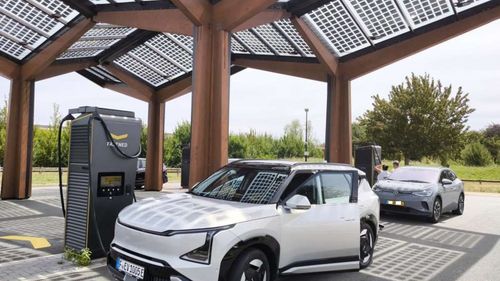
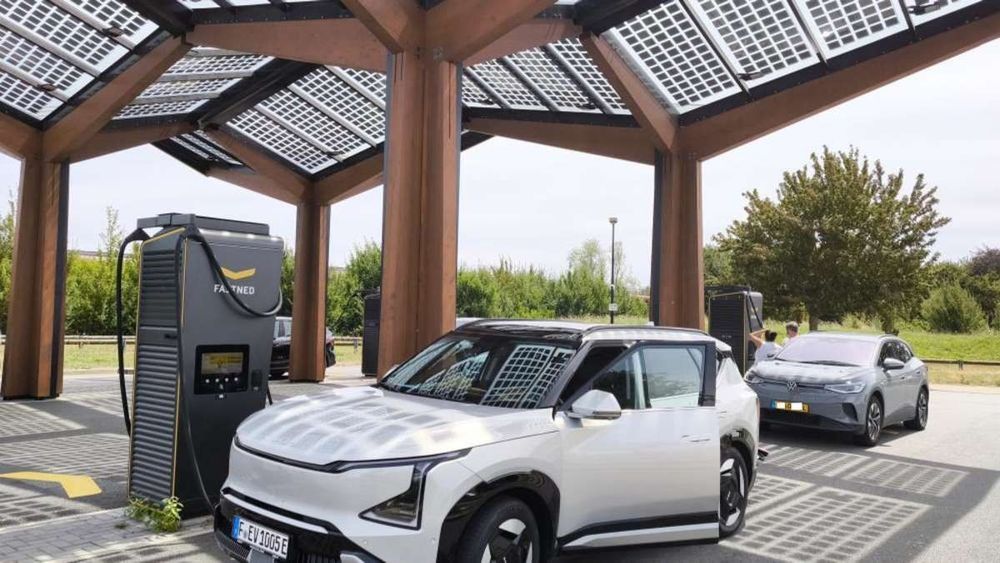
Fast charging was the main compromise. The EV5 sustained its 150 kW peak only briefly, and the team's best session added 63 kWh in 42 minutes. SP-X identified the 400-volt architecture as a limitation and recommended looking at an 800-volt model if minimizing charging breaks is a priority.
Room for camping, with power at the campsite
At 4.61 meters long, the five-seat EV5 accommodated the group's luggage and camping equipment without difficulty. Kia lists 566 liters of rear cargo space, expandable to 1,650 liters, plus a 44-liter front trunk. The testers put a luggage roll on a bicycle carrier to preserve visibility through the rearview mirror; the carrier could alternatively have held two bicycles. The hitch supports a 100-kilogram vertical load, and braked towing capacity is 1.2 metric tons.
The cabin takes a relatively conventional approach, as does the exterior, which SP-X found more restrained than the smaller EV3 and EV4. A broad display panel combines the instruments and infotainment screen. Touchscreen controls and touch-sensitive buttons generally worked smoothly, including with Android Auto, though the team preferred using its mirrored smartphone for music and Google Maps.
SP-X considered the materials acceptable despite extensive hard plastic in the lower cabin. Door and center-console storage, cupholders, a charging tray and USB ports provided places for everyday travel essentials.
The vehicle-to-load, or V2L, function was particularly useful at campsites without electrical hookups. A 230-volt adapter stored in the front trunk plugged into the charging port, allowing the car to power an electric cooler continuously. Several days of use noticeably reduced the battery charge and had to be included in route planning, but the reviewers found the battery had enough reserve to make external power a practical camping benefit.
Comparison results and safety scores
In a separate electric-SUV comparison, German magazine Auto Motor und Sport ranked the EV5 ahead of the Tesla Model Y, XPeng G6 and MG S6 EV. Its combined vehicle-characteristics score was 404 points, versus 337 for the Model Y, a 67-point lead. The Kia beat the Tesla in four of the seven categories: body, safety, comfort and driving performance.
Euro NCAP's 2025 assessment of the left-hand-drive, 160 kW, two-wheel-drive EV5 recorded scores of 83% for adult occupant protection, 85% for child occupant protection, 74% for pedestrian protection and 80% for safety assist.
Awards and sales in South Korea
The EV5 received two honors at the EV Awards 2026: South Korea's Electric Vehicle of the Year and Consumers' Choice Electric Vehicle of the Year. Seoul Economic Daily reported that the ceremony took place alongside the opening of EV Trend Korea 2026 on August 25, 2026.
The newspaper also reported that Kia's South Korean EV sales reached a first-half record of 72,078 vehicles in 2026, with the EV5 helping lead that performance. The EV5 contributed 15,965 sales, compared with 18,431 for the EV3 and 15,000 for the PV5.
Pricing the useful equipment
SP-X's overall assessment was of a balanced, versatile electric SUV whose space, comfort and usable range suited a family vacation. Buying those qualities requires a substantial initial outlay: the base Air starts at 45,990 euros, or roughly 46,000 euros.
The Earth trim starts at 49,300 euros and includes V2L, which the reviewers strongly recommended. They considered the GT-Line, starting at 52,300 euros with massage seats, a Harman-Kardon audio system and 19-inch wheels, less necessary, as well as the optional 4,000-euro all-wheel-drive upgrade.
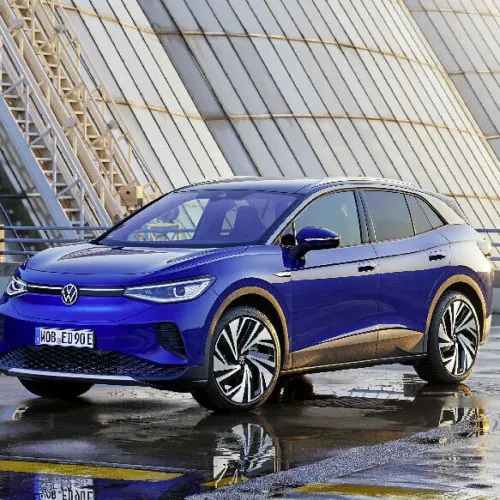
For comparison, the VW ID Tiguan starts at 51,350 euros with a 77 kWh battery in mid-level Life trim. SP-X also named the Skoda Enyaq and Renault Scenic E-Tech as alternatives.