TTF gains about 32% this month
The Dutch TTF benchmark gained 2%, bringing its increase for the month to roughly 32%. The war in Iran continues to restrict supplies from Middle Eastern producers.
Despite the recent rise, prices remain well below the peaks of the 2022 energy crisis triggered by Russia's invasion of Ukraine. Dutch TTF prices then climbed above €300 per megawatt-hour.
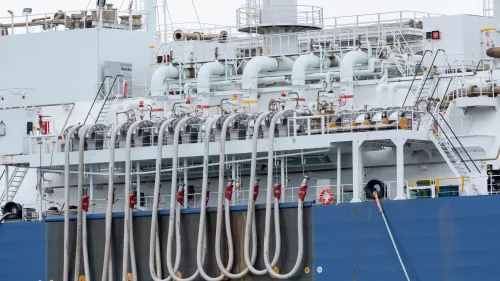
LNG supply losses and shipping risks
UBS estimates that Middle Eastern liquefied natural gas supply declined by about 60 billion cubic meters (bcm) between March and September 2026. Additional production elsewhere offset nearly 40 bcm of that loss, with the United States contributing 17 bcm. During the same period, Asian LNG imports were down about 9 bcm from a year earlier, while European imports fell roughly 10 bcm.
Shipping also faces continued security risks. Maritime security tracking data cited by Pipeline & Gas Journal identified October 2026 as the worst month for attacks on commercial vessels in the Strait of Hormuz and surrounding waters.
Rystad Energy puts global LNG portfolio costs for 2026 at $256 billion, 18% above its pre-war forecast. For Europe, it expects an LNG bill at least $12 billion, or 18%, higher even as demand declines by 24 million metric tons.
Storage remains low ahead of winter
EU gas storage was about 74.6% full in late October and had stayed near that level for roughly a week, according to Gas Infrastructure Europe data reported by Pipeline & Gas Journal on October 26.
Earlier in the month, inventories were substantially below their year-earlier level. ENTSOG's Winter Supply Outlook 2026/27, released October 8, recorded underground storage at 72% on October 1, equivalent to about 811 terawatt-hours (TWh), or 74 bcm. That compared with 83%, approximately 940 TWh or 85 bcm, on October 1, 2025. The 2026 starting level was broadly comparable to the beginning of winter 2021/22.
In ENTSOG's assessment, continued limits on LNG availability could leave storage well below 30% at the end of winter 2026/27. Meeting demand under its Reference Winter scenario while preserving a 30% storage level would require approximately 1,060 TWh, or 96 bcm, of LNG over the winter.
The European Commission nevertheless said on October 8 that the EU gas system has enough flexibility to meet winter demand despite inventories being below historical levels. It distinguished current conditions from winter 2021-2022, pointing to more diversified supplies, greater LNG import capacity and lower gas demand.
Forecasts hinge on disruption and weather
UBS now forecasts an average Dutch TTF price of €75/MWh for the fourth quarter of 2026, up from €62, and €45/MWh for 2027, up from €40.
Its alternative scenarios span a wide range. If disruption persists alongside colder weather, UBS expects a fourth-quarter average of €90/MWh and possible peaks near €120/MWh. A quicker recovery in Qatari shipments combined with mild temperatures could instead bring the quarterly price toward €50/MWh.
International Energy Agency Executive Director Fatih Birol said on October 26 that energy markets would remain tighter in 2027 than they were before the war.