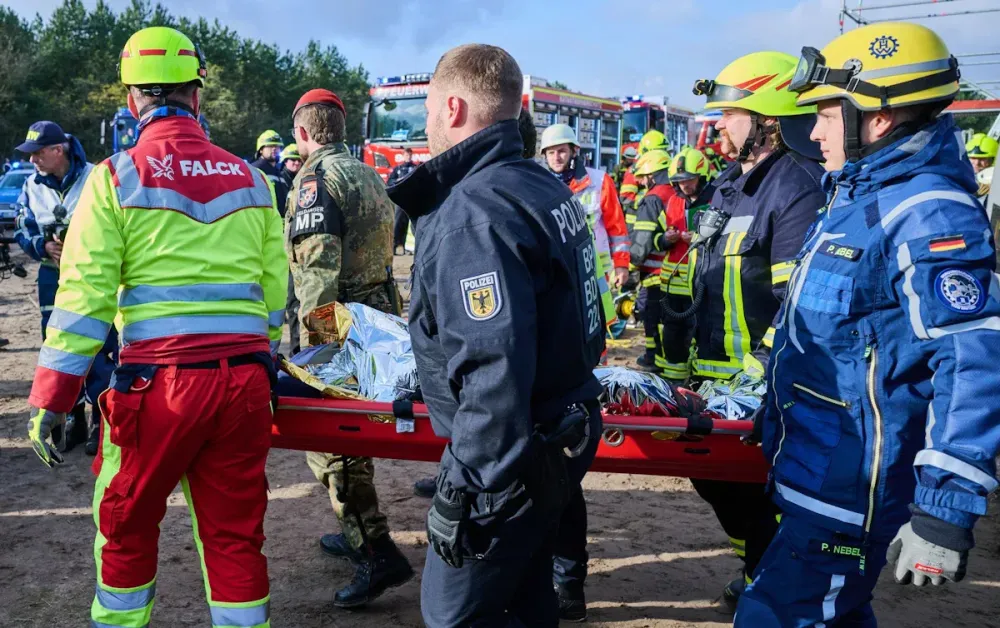
A mass-casualty response without mobile service
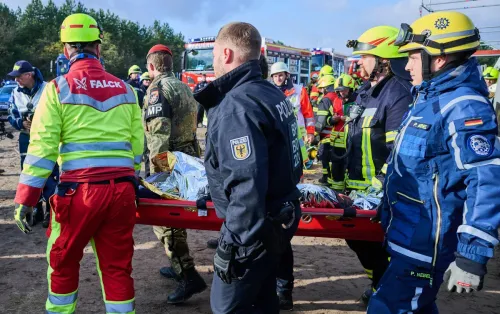
MURE 26 brought together the Bundeswehr, police and civilian emergency services near Weißkeißel in the Görlitz district. The exercise ran October 27-29, 2026, with 1,100 participants representing more than 50 authorities, organizations and associations. Emergency personnel came from more than 25 municipalities.
The scenario involved a passenger train colliding with a military transport. According to Radio Lausitz, the military train was carrying Bundeswehr equipment during a troop deployment to NATO's eastern flank. Firefighters, police, rescue services and civil protection personnel were called out under MANV, the German designation for a mass-casualty incident.
On the first day, responders had to bring 50 seriously injured people to safety from a remote location without mobile phone coverage. An overturned passenger car lay in front of a station, and the military transport had also tipped over. Fire engines, ambulances and Technisches Hilfswerk vehicles surrounded the site with emergency lights flashing. Helicopters circled overhead and lowered rescuers by rope to retrieve casualties.
The Bundeswehr participants included forces from its Support Area, among them Feldjägerregiment 1 and Landeskommando Sachsen. Federal Interior Minister Alexander Dobrindt of the CSU and Defense Ministry State Secretary Nils Hilmer attended the closing visitor day.
Testing radio capabilities and limits
The main focus of MURE 26, short for Mutuality/Reciprocity, was Digitalfunk BOS, Germany's nationwide standard for emergency-service communications. The exercise emphasized joint service, coordinated rescue work and reliable communications.
Digitalfunk BOS supports voice calls and short messages, but not video or large data transfers. That limitation is one reason work is underway to adapt emergency radio to future requirements.
Dobrindt said the exercise was intended both to demonstrate how agencies can cooperate during a crisis and to expose areas needing improvement. He praised the participants' performance.
He also called for stronger technical communications. Existing systems work, he said, but need to keep pace with increasing digital demands. He described the expansion of next-generation broadband digital radio as essential, said all responders must be able to use the same technical systems, and urged closer integration of military and civil defense.
A real crash during the exercise
For Görlitz district fire chief Björn Mierisch, news from Spain was difficult to absorb. He told dpa that after six months of preparing the train crash scenario, he had returned home pleased that the first exercise had gone well, only to see images of the Spanish disaster on television. He described the experience as frightening and distressing.
The Spanish collision occurred on the morning of October 28, 2026, in the central province of Toledo. A Renfe high-speed train struck a stationary Iryo train. Authorities reported at least 68 deaths and more than 100 injuries. About 540 passengers were aboard the two trains, which were traveling from Madrid toward Andalusia.
Spain's transport minister, Óscar Puente, attributed the crash to an incorrect instruction from the rail control center after the automatic safety system failed. Prime Minister Pedro Sánchez ordered three days of national mourning.
Dobrindt said the accident showed how quickly an abstract exercise scenario could become real. He said he had offered condolences and support to his Spanish counterpart.
The wider civil-military plan
The federal cabinet approved the exercise in summer 2025 alongside additional cybersecurity measures. MURE 26 forms part of Operationsplan Deutschland, which sets out civil-military cooperation in peacetime, during hybrid threats and crises, and in war.
The classified plan runs to about 1,400 pages. Its first version was completed in spring 2024, and it is continuously updated. In a crisis, it provides for moving up to 800,000 allied soldiers and 200,000 vehicles through Germany within six months and supplying them under Host Nation Support.
Defense Minister Boris Pistorius has described Germany as NATO's logistical center in Europe, with alliance defense depending on routes through its roads, railways, ports and airports in an emergency. The plan identifies what the military requires from civilian organizations. Pistorius has stressed that emergency plans need to be practiced, not merely written.
MURE 26 also falls under the Pakt für den Bevölkerungsschutz, which includes modernizing emergency communications. Under that framework, the federal government plans to invest 10 billion euros in civil protection by 2029, including modern warning and communication systems. The Interior Ministry is also establishing a Steuerungsstab Kommando Zivile Verteidigung to coordinate civilian and military planning more closely.