
Support for Aigner, but no commitment from Frei
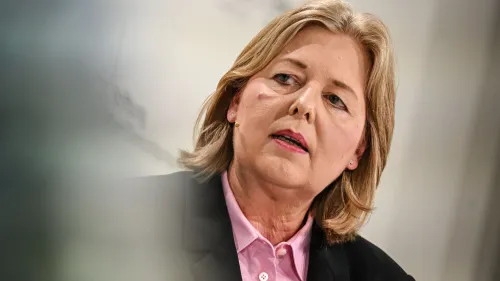
Speaking to Bild, Frei said Aigner, the president of Bavaria's state parliament, had demonstrated her suitability over decades in Bavarian and national politics. He did not disclose whom the CDU and CSU would nominate.
Frei expects the two party chairs to present a joint proposal within days. He predicted that their choice would attract broad support beyond the CDU/CSU and its coalition partner, the SPD, and expressed confidence that Germany would get an excellent female president.
The CDU's presidium and executive board are scheduled to discuss Steinmeier's succession on Monday. The CSU has already endorsed Aigner, and all CDU state premiers in eastern Germany now openly support her.
The CSU first put Aigner's name forward in April and formally backed her at its Munich party congress about two weeks before early November 2026, according to Der Tagesspiegel's dpa report. The SPD and the Greens have also shown sympathy for the 61-year-old.
Other candidates remain in contention
Frei emphasized that Aigner was not the only woman capable of taking on the presidency. In an appearance on Welt TV the previous week, he had declined to commit to her and cited Bundestag President Julia Klöckner, Education Minister Karin Prien and former CDU leader Annegret Kramp-Karrenbauer as other well-qualified possibilities.
Der Tagesspiegel's dpa report also names European Commission President Ursula von der Leyen and Ines Claus, who leads the CDU parliamentary group in Hesse, among the possible CDU candidates. The report says Klöckner had recently been viewed as Aigner's strongest potential rival.
Chancellor and CDU leader Friedrich Merz told CDU district chairs that he wanted to propose a joint candidate from the political center. The report interpreted that position as a sign that he wanted to involve the Greens in the search.
The votes behind the nomination
State-level support matters because half of the Federal Convention's electors come from Germany's states. That gives CDU state premiers and state party leaders a decisive role in the nomination, according to Der Tagesspiegel's dpa report. The CDU, CSU and SPD together hold a majority of about 50 votes in the body.
A woman would be a first for the presidency: all 12 heads of state in the Federal Republic's 77-year history have been men. An Aigner presidency would also be the first for the CSU. Six previous presidents came from the CDU, three from the SPD and two from the FDP; Joachim Gauck had no party affiliation.
Election set for January 30
The 18th Federal Convention, or Bundesversammlung, will meet at the Bundestag on Saturday, January 30, 2027, to elect the next president. According to the Bundestag, Klöckner set the date on February 26, 2026, and informed its Council of Elders.
The convention has 1,260 members: 630 Bundestag lawmakers and 630 delegates chosen by the state parliaments. A candidate needs an absolute majority of at least 631 votes in either of the first two ballots. If neither ballot produces a winner, a plurality is enough in the third.
Steinmeier's second term ends on March 18, 2027. Having served two terms, he cannot run again.