
An unfamiliar name for the highest office
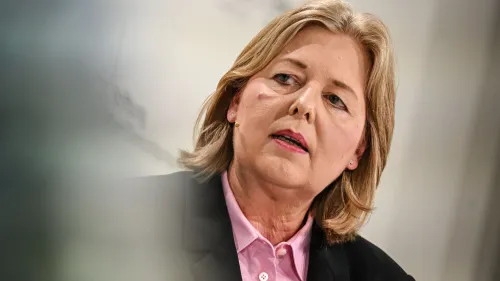
Addressing the Hessian CDU politician in his daily column, the 72-year-old Martenstein admits he had not known who she was despite regularly reading newspapers. He casts her identity as a potential 125,000-euro question on Günther Jauch's version of "Who Wants to Be a Millionaire?" His mock answers include a patron saint of Clausthal-Zellerfeld, a member of a duo called "Claus und Claus" and Santa Claus's sister.
Claus's arrival among the names under discussion for the presidency prompts a comparison with the rapid rise of the boxer Rocky. But Martenstein's main target is the selection process: he portrays party calculations, predictability and an ability to avoid trouble as the qualities that matter.
In his satirical job description, political balancing dictates that the next president be a woman from the CDU/CSU, leaving, he jokes, only about 125,000 possibilities. The preferred candidate should read ghostwritten speeches smoothly, be as predictable as "Wort zum Sonntag" and leave no particularly large gap in the party upon departing. Being chosen on those grounds, he suggests, might be more insulting than flattering.
Claus's record and limited public backing
Claus, 49, has led the CDU parliamentary group in Hesse since 2020 and has been one of party leader Friedrich Merz's six federal deputies since early 2026, according to tagesschau.de. She is Catholic and has three children.
She entered the Hessian state parliament in 2018. Two years later, then-Minister-President Volker Bouffier elevated her to the parliamentary leadership, succeeding Michael Boddenberg. She was subsequently considered for a federal ministerial position when Merz formed his cabinet but declined early, tagesschau.de reports.
Her presidential prospects had not translated into explicit public endorsements as of late October 2026. According to tagesschau.de, nobody had publicly backed her for the office, including within the Hessian CDU. SPD politician Hubertus Heil told ARD he did not know her, while Green Bundestag Vice President Omid Nouripour expressed strong irritation at the prospect of her becoming president.
Her election would mark two firsts. None of Germany's 12 federal presidents has been a woman or come from Hesse. Previous officeholders include Joachim Gauck, Richard von Weizsäcker and Theodor Heuss.
Aigner and the CDU's nomination claim
Claus is being discussed alongside Ilse Aigner, the CSU politician who heads Bavaria's state parliament. CSU leader Markus Söder has publicly proposed Aigner, who has support from the SPD, including its Bundestag parliamentary group leader Matthias Miersch, and is viewed favorably by the Greens, according to tagesschau.de.
The CDU nevertheless insists on putting forward its own candidate rather than yielding the nomination to its Bavarian sister party. STERN.de reports that the CDU claims the right to nominate as the largest parliamentary group in the Bundesversammlung, the assembly that elects the president.
According to STERN.de, the CDU leadership planned to discuss the nomination at its executive committee meeting on November 9, 2026. Merz intended to settle on a name after returning from an Asia trip.
Who chooses the president
Martenstein contrasts the party-led process with polling that, he writes, shows about 70% of Germans favor directly electing the president. He sarcastically suggests that asking voters might reveal an inconvenient preference. His closing jab presents a Claus presidency as another gesture against populism and questions whether that is the overriding consideration, before wishing her success.
The election will instead take place in the 18th Bundesversammlung, which Bundestag President Julia Klöckner scheduled on February 26, 2026, to meet at the German Bundestag on January 30, 2027. According to the Bundestag, its 1,260 members comprise all 630 Bundestag lawmakers and 630 delegates selected by state parliaments. The governing CDU/CSU-SPD coalition has a stable majority in the assembly, tagesschau.de reports.
The winner will succeed Frank-Walter Steinmeier, whose term ends on March 18, 2027. Having served two terms, he cannot run again.